


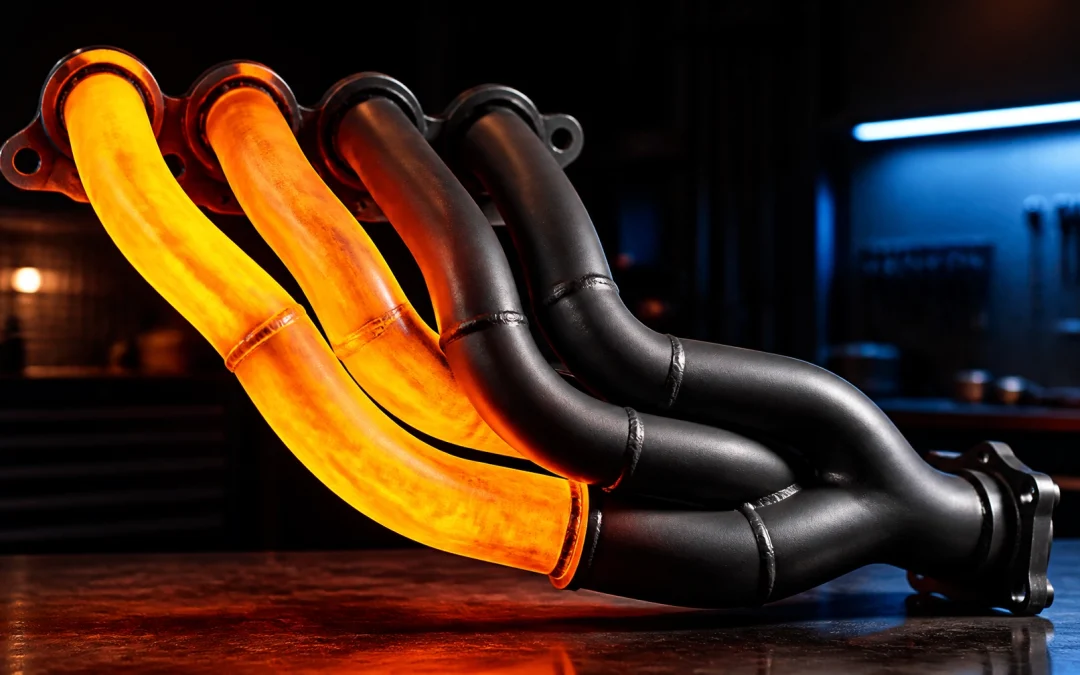
So, you’ve spent the last six weekends in the garage, your knuckles are basically one giant scab, and your project car is finally starting to look like something that belongs on the road rather than a scrap yard. You get to the exhaust, look at those rusty headers, and think: "Can I just powder coat my exhaust pipes?"
It’s a fair question. Powder coating makes everything look like a million bucks, wheels, frames, even your old patio furniture. But before you go tossing your headers into a standard powder booth, we need to talk about heat. Because if you get this wrong, your fancy new finish is going to melt, flake, and smell like a burning tire factory about five minutes into your first drive.
At Powder Coat It, we’ve been helpin' folks in Santa Cruz, the Bay Area, and Monterey get their builds right since 2010. We love a good powder finish, but when it comes to the "hot side" of your engine, there’s a clear winner.
Let’s break down the ultimate face-off: Ceramic Exhaust Coating vs. Powder Coating.
Can You Powder Coat an Exhaust? (The "Yes, But…" Answer)
Technically, yes, you can powder coat parts of an exhaust. But: and this is a big "but": it depends entirely on where that part lives in the system.
Standard powder coating is essentially a plastic resin that gets baked onto a part. Most standard powders are rated to handle temperatures around 300°F to 400°F. Some specialized "high-temp" powders can stretch that to 1,000°F.
Here’s the problem: Your exhaust headers and manifolds? They can easily reach 1,200°F to 1,600°F during normal operation. If you’re running a turbo, those housings can see 1,800°F+.
If you put standard powder on a header, it’s going to fail. Fast. It’ll discolor, turn chalky, and eventually peel off in sad, charred flakes. However, powder coating is perfect for parts that stay a bit cooler, like:
- Exhaust hangers and brackets
- Tailpipes and tips (at the very end of the system)
- Heat shields that aren't bolted directly to the manifold

High-temp powder coating is great for engine accents like these valve covers, but your headers need something beefier.
The Heavyweight Champ: Ceramic Exhaust Coating
When standard powder taps out, ceramic coating (specifically Cerakote) steps into the ring. Ceramic coatings aren't just "fancy paint." They are advanced thermal barriers designed to live in the hottest environments on earth.
At Powder Coat It, we specialize in high-performance ceramic finishes that are rated up to 2,000°F. Whether you're cruising down West Cliff Drive or pushing triple digits at Laguna Seca, a ceramic coating isn't going to flinch.
Why Ceramic is the Move for Your Headers and Turbos:
- Insane Heat Resistance: While powder starts sweating at 400°F, ceramic is just getting warmed up. It won't flake, peel, or discolor under the extreme thermal cycling of a high-performance engine.
- Thermal Management: This is the big one. Ceramic coating keeps the heat inside the pipe. This means your engine bay stays significantly cooler: often dropping under-hood temperatures by as much as 100°F or more. Your wires, hoses, and plastic bits will thank you.
- Performance Boosts: Keeping the heat in the exhaust gas increases exhaust gas velocity (scavenging). In simple terms: the hotter the air stays in the pipe, the faster it moves out, which can actually help your engine breathe better and make more power.
- Turbo Protection: If you’re running a turbocharger, ceramic coating the housing is a no-brainer. It keeps the heat energy focused on spinning that turbine rather than soaking into your intake and killing your power.

Comparison: Head-to-Head
| Feature | Powder Coating | Ceramic (Cerakote) |
|---|---|---|
| Max Temp | 400°F (Standard) / 1,000°F (High-Temp) | 1,800°F – 2,000°F+ |
| Best For | Wheels, frames, brackets, tips | Headers, manifolds, turbos, downpipes |
| Heat Insulation | Minimal | High (Reduces engine bay heat) |
| Corrosion Protection | Excellent (at low temps) | Incredible (even at extreme temps) |
| Color Options | Near infinite | More limited, but very sleek & metallic |
Beating the Santa Cruz Salt Air
If you live in Santa Cruz, Watsonville, or anywhere near the Monterey Bay, you know the struggle. That salty sea breeze is like acid for bare metal. If you leave your headers raw or use a cheap "rattle can" high-temp paint, they’ll be covered in rust within a few months.
Both powder and ceramic provide a hermetic seal against oxygen and moisture, which is the only way to stop the "Santa Cruz Rust" from eating your investment. But for parts that get hot, ceramic is the only coating that won't crack under the pressure, keeping that salt out for the long haul.

What Parts Should You Send Us?
If you’re planning a visit to our shop on Soquel Avenue, here’s a quick guide on how to divide up your parts:
Ceramic Coating (Cerakote) for:
- Exhaust headers and manifolds
- Turbocharger housings (hot side)
- Downpipes
- Motorcycle exhaust pipes
- External wastegates
Powder Coating for:
- Intake manifolds (usually stay cool enough)
- Valve covers
- Intercooler piping (cold side)
- Exhaust tips (if they don't get direct flame)
- Engine bay brackets and pulleys

The Verdict: Don't Melt Your Money
We love powder coating exhaust pipes: if they are the tips. But if you're looking at your headers, "can you powder coat an exhaust" isn't the question you should be asking. The real question is: "How fast do I want to have to do this over again?"
Do it once, do it right. If it’s hot, ceramic is the only way to go. If it’s cool, powder coating is the ultimate style upgrade.
Whether you’re a local Santa Cruz enthusiast or you’re shipping your parts to us from San Francisco or LA, we’ve got the ovens and the expertise to give your ride that professional, durable finish it deserves. Check out our ceramic exhaust page for more details, or just swing by the shop!
Powder Coat It
7000 Soquel Avenue
Santa Cruz, CA 95062
Phone: (831) 435-9558
Website: www.powdercoatitsc.com
Recent Comments